
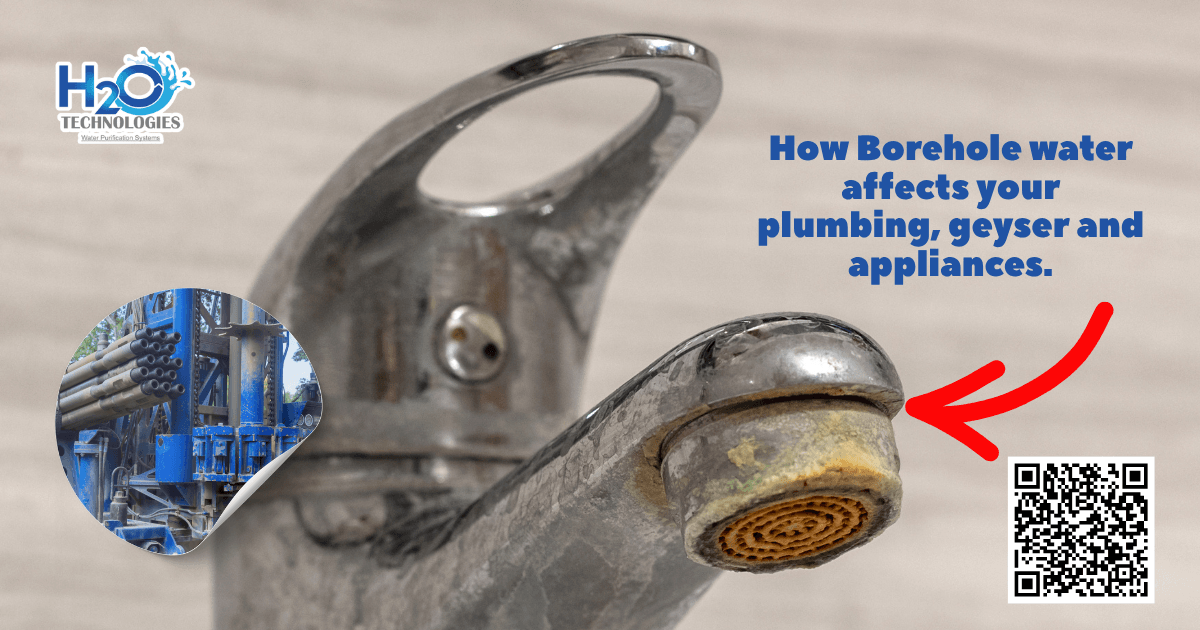
Boreholes are becoming an increasingly important source of water for homes, businesses, farms and institutions across Zimbabwe. They provide an alternative to municipal supplies and can be particularly valuable where water availability is unreliable.
But there is an important point many borehole owners discover only after installation:
Clear water is not necessarily problem-free water.
Borehole water can contain naturally occurring minerals such as calcium, magnesium, iron, manganese and fluoride. Depending on the geology and location of the borehole, it can also be affected by agricultural activity, sewage contamination, mining activity and other sources of groundwater pollution.
One of the most visible problems is hard water and lime scale — the white, chalky deposit that gradually appears inside kettles, on taps, showerheads, pipes and geyser elements.
At H2O Technologies, we provide water testing and water treatment solutions for borehole water in Zimbabwe, including solutions for hardness and lime-related problems. But before choosing a treatment system, it is important to understand what may actually be happening with your water.
What is “lime” in borehole water?
When people in Zimbabwe refer to “lime” in borehole water, they are often describing the white mineral scale left behind when hard water is heated or evaporates.
Hardness is mainly associated with dissolved calcium and magnesium. Zimbabwean groundwater studies have found hardness to be a significant issue in some areas, with particularly high values recorded in parts of the country. Groundwater chemistry can vary considerably from one location to another because it is influenced by the underlying geology. (ScienceDirect)
This is why two boreholes only a few kilometres apart can sometimes have completely different water characteristics.
You may have one borehole producing relatively soft water while another produces water that quickly leaves white deposits on household appliances.
How do you know if your borehole water is hard?
Some common signs include:
- White deposits around taps and showerheads
- A white or chalky layer inside an electric kettle
- Scale accumulating around geyser heating elements
- Soap and detergents not lathering effectively
- White marks on bathroom surfaces
- Reduced water flow through some fittings
- Frequent replacement or cleaning of showerheads and tap aerators
- Geysers taking longer to heat water
- Unusual deposits inside plumbing equipment
However, looking at the water is not enough to determine its hardness.
The water may look completely clear while still containing significant concentrations of dissolved minerals.
A proper water analysis provides a much better picture.
What does hard borehole water do to an electric kettle?
The electric kettle is often one of the first places where homeowners notice hard water.
Every time water is boiled, some dissolved minerals can precipitate and form limescale on the heating surface.
Initially, it may appear as a thin white film. Over time, it can become a thick, crusty layer.
The problem isn’t simply that the kettle looks dirty.
The mineral layer can interfere with heat transfer between the heating element and the water. Thick scale can therefore affect the kettle’s performance and contribute to more frequent maintenance or replacement.
This same principle becomes much more important when the heating element is inside a geyser.
How borehole lime affects your geyser
A geyser heating element transfers heat into the surrounding water. When hard water is repeatedly heated, mineral deposits can accumulate around the element.
Eventually, the element can look dramatically different from when it was installed — sometimes covered in a thick white layer of scale.
Research into water hardness and geyser heating elements has specifically investigated how hardness-related scaling can affect the energy performance of heating elements. (SciELO)
As scale builds up, several problems can develop:
1. Reduced heat transfer
The scale acts as an insulating layer around the heating element, making heat transfer less efficient.
2. Longer heating times
The geyser may take longer to bring water to the desired temperature.
3. Increased energy consumption
When the heating system has to operate less efficiently, this can contribute to higher electricity consumption.
4. Heating element failure
Severe scaling can contribute to premature failure of the element and increase maintenance costs.
5. More frequent repairs
What begins as a water-quality issue can eventually become a plumbing and appliance-maintenance problem.
This is why treating the water itself can be more useful than repeatedly replacing the affected component.
Lime doesn’t only affect the geyser
It is easy to think of the geyser as the main victim of hard water.
It isn’t.
Your entire plumbing system is exposed to the water.
Over time, mineral deposits can accumulate on:
- Taps
- Showerheads
- Pipes
- Valves
- Water heaters
- Washing-machine components
- Dishwashers
- Toilet fittings
- Water pumps and associated components
The severity depends on the actual water chemistry, temperature, flow conditions and how long the system has been operating.
So if you keep replacing the same plumbing component and the problem keeps coming back, it may be worth asking:
“Is the water causing the problem?”
Borehole water near a septic tank: a different concern
Lime and hardness are primarily water chemistry problems.
A borehole located too close to a septic tank, pit latrine, cesspit or other wastewater source introduces a different concern: microbiological and chemical contamination.
This is particularly important because contamination is not necessarily visible.
Water can look clean and still contain bacteria or elevated nitrate levels.
Zimbabwean research has found groundwater quality concerns including elevated nitrate levels in some boreholes. More recent research in Harare has also reported E. coli and other groundwater-quality concerns in some sampled areas. (ScienceDirect)
Local requirements can also matter. For example, Bulawayo’s sewerage and drainage by-laws specify a 30-metre separation for boreholes used for drinking or animal watering from certain sanitation facilities, including septic tanks and pit latrines. (City Byo)
That doesn’t mean every Zimbabwean location has identical conditions or requirements. Borehole location, construction, geology and sanitation arrangements all matter.
If your borehole is close to a septic tank, soakaway, pit latrine or other possible contamination source, water testing should be taken seriously.
What if your borehole is in a mining area?
Mining areas require another level of caution.
Mining activity can alter groundwater chemistry, while the underlying geology itself can also contribute naturally occurring metals and minerals to groundwater.
Zimbabwean groundwater research has found elevated iron and manganese in some areas and linked some elevated manganese levels to geology as well as mining activity. Fluoride has also been elevated in some areas because of geological conditions. (ScienceDirect)
This does not mean that every borehole near a mine is contaminated.
It means you shouldn’t make assumptions.
If your borehole is:
- Near active or abandoned mining operations
- Near mine tailings
- In a known mineral-rich geological area
- Near industrial activity
- Near agricultural chemical use
- Near waste disposal areas
then a more comprehensive water analysis may be appropriate rather than simply installing a standard household filter.
The treatment should follow the test results.
Don’t buy a water filter before testing your water
This is one of the most important principles when dealing with borehole water.
There is no single “borehole filter” that solves every water problem.
For example:
Hardness/lime → may require a water-softening solution.
Suspended particles → may require appropriate sediment filtration.
Iron → may require iron-specific treatment depending on concentration and chemistry.
Microbiological contamination → may require disinfection such as UV or another suitable treatment process.
Dissolved contaminants → may require technologies such as reverse osmosis or other specialised treatment.
The correct solution depends on the water.
A Zimbabwean borehole water study found substantial variation in parameters including hardness, conductivity, nitrate, iron, manganese, fluoride and other characteristics across different areas. (ScienceDirect)
That is why testing should come before treatment selection.
The appropriate test panel depends on the situation.
A household borehole in a residential area may require a different assessment from a borehole located near mining operations, agricultural land or sanitation facilities.
So, do you need a water softener?
Not necessarily.
A water softener should not be installed simply because the water comes from a borehole.
The first question should be:
How hard is the water?
If testing confirms significant hardness and you are experiencing scale on your geyser, kettle, pipes and other equipment, a properly selected water-softening system can help reduce the calcium and magnesium responsible for hardness and consequently reduce scale formation.
But if your primary problem is bacteria, iron, sediment or another contaminant, a softener alone will not solve it.
The right treatment depends on the problem.
Free Borehole Water Testing from H2O Technologies
At H2O Technologies, we believe water treatment should begin with understanding the water.
If you are experiencing:
“My kettle keeps getting white deposits.”
“My geyser element is covered in lime.”
“My taps are developing white scale.”
“My borehole water doesn’t feel right.”
or you simply want to know what is actually in your borehole water, H2O Technologies offers free water testing to help identify potential water-quality and hardness issues.
Based on the results, appropriate treatment options can then be considered — whether the requirement is water softening, filtration, UV disinfection, reverse osmosis, or a combination of treatment technologies.
We don’t believe in selling the same system to everyone.
Test the water. Understand the problem. Then choose the solution.
Final thought: Your borehole water may be clear, but what’s inside it?
Borehole water can be an excellent water source, but groundwater is not chemically identical everywhere in Zimbabwe.
The same water that looks perfectly clean can contain enough dissolved minerals to gradually scale a kettle or geyser. In another location, the concern could be iron, manganese, fluoride, nitrate or microbiological contamination.
That’s why water testing is one of the most important steps after drilling a borehole — and not something to consider only after your geyser or plumbing has already suffered damage.
If you have a borehole in Zimbabwe and would like to understand your water better, contact H2O Technologies for free water testing and professional water treatment solutions.
💧 H2O Technologies
Water Purification | Water Softening | Filtration | Reverse Osmosis | UV Treatment | Water Testing
Test your water. Know your water. Treat your water correctly.